FRED
Local 3D printing: bringing production closer to delivery
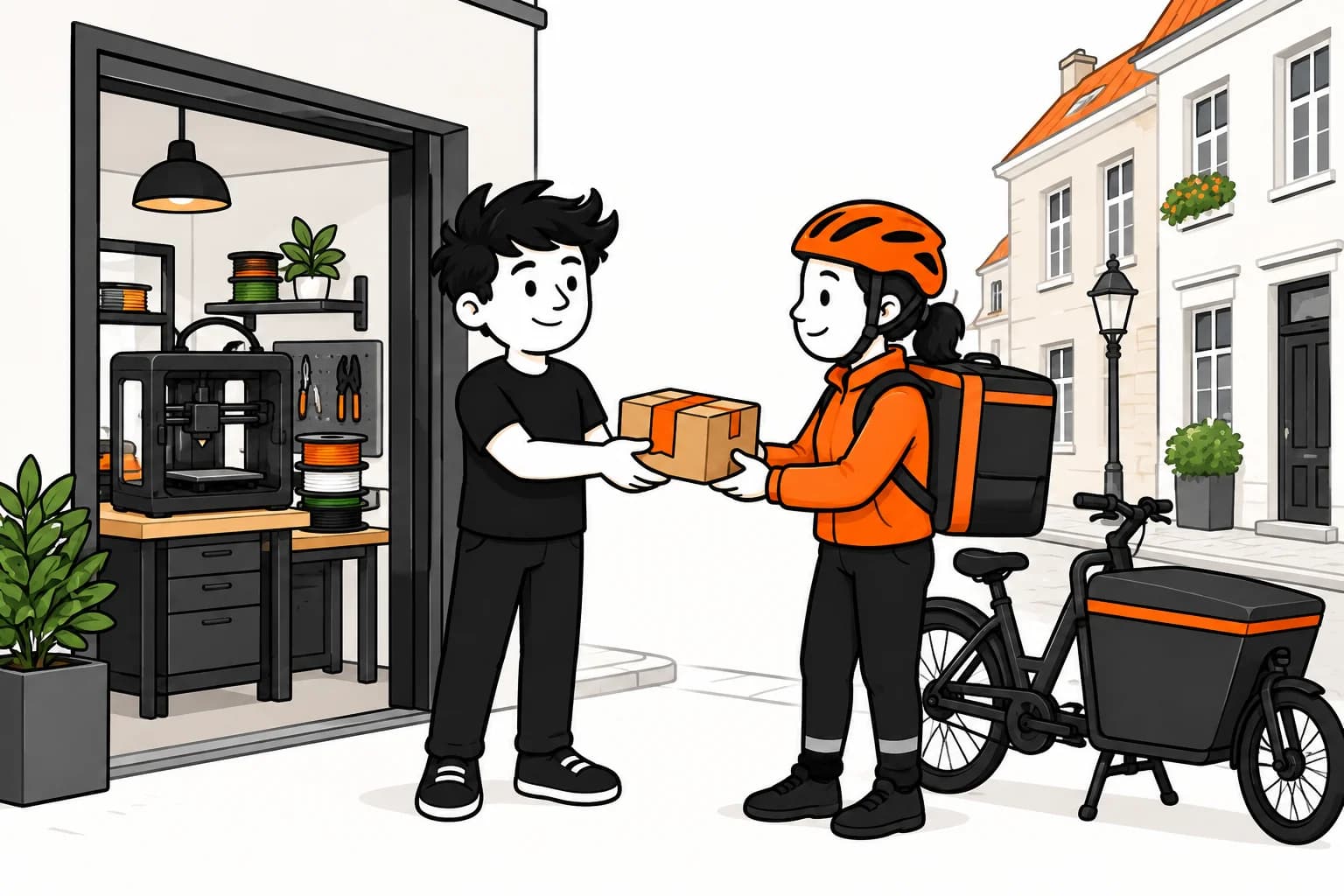
Producing closer to customers can shorten a parcel’s journey. FRED is building a network of 3D print farms to progressively bring manufacturing closer to demand. Speed also depends on printing time, workshop availability and the carrier: distance alone is not enough.
In this article
Why distribute production?
A central warehouse ships every product from one location. A distributed manufacturing network can use different workshops depending on the order. The digital file becomes the starting point for production, without building finished-goods inventory in every region in advance.
FRED’s ambition is to extend that proximity to more destinations by bringing farms into the network’s shared framework. The private beta is not a promise of coverage in every city or country.
How does FRED choose a workshop?
FRED first looks for capabilities compatible with the order. Ranking considers estimated dispatch, quality, distance and workload depending on the workflow. A nearby but busy workshop is therefore not necessarily the best choice.
Illustrative example: for the same object, a more distant farm with available capacity may dispatch before a neighbouring farm whose machines are already busy. Check the estimate for your order instead of inferring timing from a map.
What makes up the delivery lead time?
Total lead time includes preparation and approvals, waiting for capacity, printing, any finishing, inspection, packaging and transport. A changed file or configuration may require preparation again.
Before promising a date to customers, check the destination, quantity, configuration and delivery conditions. Use the lead time offered for your actual order.
Ready to sell without inventory?
The beta is opening gradually. Sign up and we'll let you know when it's your turn.
Request access